Showing posts with label Bond bubble. Show all posts

Friday, May 21, 2010

China: Still hot despite Credit and Property Bubble worry

Am I being too bullish on China or am I reading all the data wrong? But guess what ,China's growth needs re-orienting viewed in terms of its current dependence on investment, currency controls, loose money etc...Though capacity utilization is at 100%..it makes me worried as in conjunction with what is happening in EU and the current mayhem in markets in the US,

It is best China taps some of its domestic constituency and unleash it...It has so many strengths in terms of consumption spending power and domestic demand in general...

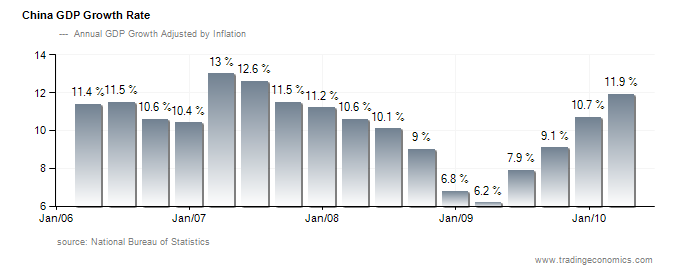
A sizzling 11.3% growth in Q1 and a consistent 8% plus avg. growth that has been envious...While the Chinese will do anything to keep unemployment down....


Recipe for Inflation: China mostly is in the grip of a bubble as its property markets are indicating and are so are credit markets. People's Bank of China recently revealed that in March the output gap reached more than 3%, the highest level since 1998 and the seventh straight month of increase. Positive output gap indicates that factories are running out to comply with high demand which in turn is likely to push prices even higher. This looks very inflationary for China in conjunction with the very level of money supply.

People's Bank allowed lending to surge starting in late 2008 to fight the global financial crisis. New loans rose to a record 9.59 trillion yuan in 2009 and banks advanced another 3.38 trillion yuan in the first four months this year. The Shanghai Composite index of stocks has fallen off more than 2o% this year, the worst-performing index in Asia, as investors sold Chinese assets on concern a withdrawal of stimulus spending and a slowdown in construction could choke off growth after an 11.9% expansion in the first quarter. (Thanks CNBC)


In Shanghai fears abound that property speculators chasing quick profits are inflating a real estate bubble. Apparently, the Chinese Government is also worried about this and is now capping prices and making some building loans harder to get.

Re-orientation critical as current strategy has outlived utility

Besides PBoC's March 2010 data, that China is facing serious overcapacity problems goes beyond real estate. According to Prof. Michael Pettis lectures of Peking University, China's understandable efforts to try and shield itself from the world economic crisis with a massive stimulus package may end up making its situation worse. I am also getting a feeling that China has reached a point where it is producing stuff or investing in infrastructure that is not economically viable; that in the future China is still not going to be able to use this stuff and Chinese people are still going to have to pay for it despite the negative NPV of so many road projects.
Pettis conclusion is stark "when that happens that will exchange future growth in exchange for the growth that we got today." "What we've seen in the last year has been a very robust reaction to the contraction in the export sector and to the threat of rising unemployment." Professor Pettis says China entered the global financial crisis with an investment rate that was probably much too high.
Look at the Chart below and it is easy to understand why China needs to stimulate consumption. The economy is way too heavily dependent on investment. Since investment rates is so high there's a very, very strong reason to believe that a lot of this investment is being wasted. Considering the monetary policy in place to allow for easy access to capital, repayment nightmares could become a big potential issue that makes any growth very inefficient....


China is not imploding any time soon as doom mongers seem to suggest.....nothing the Chinese cannot handle...

Sunday, May 02, 2010

US Bond Market Bubble: Support


These are support images for the prior post on US Bond Market Bubble. Essentially these are data from ICI Institute and from CNN Money showing net cash flows and yields on bonds over 1995-2009 and also the current spreads between US Treasury bills and Corporate Bonds.

Another aspect that points to a bear market in addition to the frightening volume numbers is the Gold Spectator web page's BEV Chart
. The Red Yield Plot shows that the US T-Bonds rising during the Stock Market Crash of October 2008. The Current Yield dropped over 200 Basis Points as the DJIA fell below its BEV -40% line.

Gold Spectator(GSR) analysis makes an interesting point that, despite seemingly rising flows, since October 2009, as a Debt Crisis stirred in Europe (worsened by April 2010 with PIGS in big trouble), some money has been slowly walking away from the US Treasury Bond Market. So the question we should all ask ourselves is whether this money is Smart or Dumb Money? GSR think it’s Smart Money and my own reading of a previous Societe Generale report correlates this opinion that too much speculative money is in bond markets with no clear objectives, a sure recipe for pain.

It is quite possible
we may be witnessing the early stages of a crisis in the US T-Bond market.

Is that possible? Yes, it’s happened before in the 1970’s. Before the 1970s, came the 1950s & 60s.All-in-all, these were 30 years of losing money in the US T-Bond market. But in the 1970’s, the flood gates of US Monetary Inflation opened wide, and US T-Bonds earned the moniker of “Certificates-of-Confiscation.”

The 2010 crisis might come on a lot more quicker and if that happens, the ensuing crisis will dwarf the 2008 debacle.

US Bond Market Bubble? Fund flows indicate yes

According to the Investment Company Institute, investors have poured almost US$ 375 bn into bond funds since the start of 2009 and in aggregate there is more than US$ 2.2 tn invested in bond funds. This massive inflow of money into bond funds and the government's purchase of government bonds as part of its quantitative easing program has made yields in the bond market come down substantially since late 2008. These bond flows are all not done wisely. Quite a bit of it been speculative and based on naïve misplaced notion that bonds are less risky. As a Societe Generale report of January 2009 notes, such investors are in for a bad surprise when rates rise in the second half of 2010 and yield curve flattens. Ditto when the ISM picks up and GDP growth sustains itself above 2.5%, bond yields will go down.

Is it a bubble then? As CNN Money opines rather correctly, the answer is nuanced. From a longer term perspective, bonds are, broadly speaking, at near all-time lows in yield. In particular, given the current loose monetary policy being implemented by the Federal Reserve, Treasury bonds are at close to all time lows in yield, and therefore highs in price. Given this extreme in Treasury bond pricing, there is clearly bubble potential in the U.S. government bond market.

Currently, 20% of all US mutual funds comprises of bond funds. The picture gets starker if the flows are considered from December 2008. Billions have exited the equity markets and have gone into bond markets. Eventhough 44% of all mutual funds are equity funds (44% of 11.1 trillion AUM in the US), outflows have been greater from equity funds on a net basis. According to Michael Belkin since last March on an average bond market funds are seeing inflows of US$ 4 bn a week while equity funds barely manage US$ 500 mn a week.

The Bond Bubble term has been bandied around for the past three years. While it is easy to make a call that an asset class is in a bubble, it is more difficult to predict timing of such a call. In addition, a bubble inherently implies that the unwinding of that bubble will be a crash. So far both have not materialized.

Charting the spread of corporate junk bonds bond versus 5-year treasuries and corporate investment grade bonds versus 5-year treasuries going back to 2002, while yields for both investment grades and junk bonds are close to their lows in yield for this period, currently at approx 8.24% versus their low of 7.75% for junk bonds and 4.7% versus their all time low of 4.5% for investment grades, the spreads between 5-year treasuries remains relatively wide. In fact, these spreads bottomed in 2007 at 0.93% for investment grade and 3.1% for junk, versus their current spreads of 2.30% and 5.74%, respectively.

The case for a US Treasury Bond Bubble: Since the price of bonds should never be taken in isolation, if there is a bubble in bonds, it is likely related to Treasuries. The case for the Treasury bubble is effectively three-fold:

1. They are being priced based on extreme monetary policy that will not be sustained in perpetuity.

2. They are incorporating very limited expectations for inflation, which we believe will occur and perhaps in dramatic fashion.

3. Finally, government bonds will eventually have to reflect the declining credit worthiness of the US based on the United States' deficit as a percentage of GDP and growing debt to GDP ratios. After health care commitment deficits have crossed 10% of GDP

Treasury bonds cannot stay at their current yield level forever. And while we have seen some correction, yields and prices for U.S. government bonds are still at generational extremes. In reality, though, just as it took decades for interest rates to come down from the meteoric highs of the 1980s, it will take interest rates time to go up, and it is likely that no crash is imminent. So even if there is a bubble, there won't likely be a "pop." This move will be long and sustained.

As CNN Money notes, from an investment perspective, the most effective way to play the re-pricing of Treasuries over time is to be short Treasuries out right, or to play a narrowing of the spread between treasuries and corporate bonds.

Small Note on Greece: While unrelated, however, Greece indicates the dangers of high bond market yields reducing equity flows as the markets are connected. Higher yields make bonds attractive and affect fund flows into equities. This will be discussed separately.