Sunday, August 22, 2010

China's Paper Tigers: Inside LICs and associated dirty secrets

All this goo ga about the PRC being a world economic power is beginning to wear me down. Simple folks...China is not going to meaingfully replace the US anytime in the near future. All those reports about China flexing its military muscles and keeping the US off the China Sea is just drivel...


Why? let me assure you that I am no knee-jerk PRC basher...but there are too many dirty things swept under the carpet in the PRC that paint a less glowing picture...despite Arthur Kroeber's rather facetious article..Victor Shih bears repeating here...


I don't think the problem is trivial, especially in light that local governments seem determined to take on trillions in additional debt in the coming two years to finance ambitious investment plans. My main worry is that unless Beijing decisively restricts local investment projects, local investment companies will continue to borrow in large quantities in the coming two years.


Even relatively bullish investment bank report suggests that new non-performing loans in the banks can increase by 2-3 trillion RMB in the next couple of years. To be sure, this is well within the government's ability to handle and likely will not lead to any kind of financial crisis. However, this remains a daunting problem for the government and for current shareholders of China's banking stocks. This will require the China Investment Corporation to inject tens of billions of dollars into banks through Huijin. Additional asset management companies will have to be formed to take over the NPLs. This is a lengthy and difficult process involving numerous ministries and interests, which is expected to generate a great deal of uncertainty. If the expectation indeed is a couple of trillions in NPLs, it deserves careful watching rather than dismissal.


Finally, some investment bank reports suggest that the enormous sum of state assets must be considered along side of the debt. If debt ever becomes a problem, the Chinese government can always sell state assets to repay the debt. Here, I am in complete agreement with my colleagues. It will be a great day when the Chinese government decides to privatize trillions in state assets to raise money to repay local debt. The record of the Chinese government in privatization, however, is spotty at best. Even in the late 1990s, when the fiscal shape of the central government was at its weakest, only small SOEs were privatized, often through murky processes to insiders. 


Since then, both the central and local governments have done their utmost to maintain the dominance of large state-owned corporations through protectionism and subsidies from both the budget and the financial system. Instead of privatizing these firms and allowing them to compete on equal footings with private and foreign firms, they are given every advantage so that they can dominate the domestic and even the global markets. The financial system in particular channels the bulk of its resources to the state sector. Unfortunately, it does not seem privatization is anywhere near on the horizon. Instead, we can expect trillions more being poured into state entities, including local investment companies, in the foreseeable future.


Victor Shih is acknowledged here

Friday, July 30, 2010

Japanese style deflation in the US?

I was wondering about the today...afterall the key indicators still show too much spare capacity, inventory already built up and wages still being depressed. Add to that the fact that the Fed has created US$ 1 trillion in reserves and has a a balance sheet size of nearly US$ 2.3 trillion

Krugman had argued that a pattern of falling prices and wages were indicative of a deflationary danger in 2009. With unemployment stubbornly near 10% and with the aforementioned indicators showing no marked improvement, St Louis Fed's Bullard rightly is worried about low interest rates.


He says in his paper “Under current policy in the U.S., the reaction to a negative shock is perceived to be a promise to stay low for longer, which may be counterproductive because it may encourage a permanent, low nominal interest rate outcome,” he said in a paper released by the St. Louis Fed.

Well the thing is as of now, the belief is that recovery will ensure that inflation rises again and the Fed goes back to contractionary monetary policy...but Bullard's fear is very real in the event that a negative shock hits the global economy. In that sense his call for buying treasuries aggressively to ease seems a valid one. The 5 yr TIPS indication of inflation expectation suggests that folks like Yellen and Bullard may be right about extended period of low rates' dangers.....

Unrelated tailpiece: The odd part is that small businesses many of which have been certified or are known to be credit worthy have been denied access to credit by banks that themselves have gained help from taxes paid by these very businesses....

too sleepy to continue the tailpiece...goodnight

Tuesday, June 01, 2010

Food Economics: Changing climate patterns, Emerging market lifestyles and US bio-fuel demand cause Global Agflation

I am back after a hiatus...I was tracking commodity prices the other day and thought hey...food inflation was not getting the attention it deserved..it is so to speak an issue of serious importance for the real economy.

The below chart shows the FAO food price index till April 2010. While the price of cereals has moderated compared to the highs seen a few months back, sugar, lentils and oils (incl. dairy) are driving global food inflation. Sugar has rocketed off the charts with the index at 309 at April 2010 compared to 257 at the end of 2009, a rise of 20% on top of the 41% rise in prices in 2009. Oils have started rising again after a 33% fall in 2009 and are up 14% YTD 2010.


As an aside, Trading on commodities has real impact on people's lives. If you buy 200 shares of Apple (NYSE:AAPL), it is not going to have such a real impact expect on you...but on the other hand, trading corn, wheat and rice on the chicago exchange is going to have a real impact and indeed is having an impact...the import of this will become clear later...

This price rise can be boiled down to a number of issues....the good old way is to look at supply vs demand and add market distortions to it to get a street level picture...

Supply Side:

Bio-Fuels and Subsidies: The US and Europe are an issue here. The farm lobby in the US has obtained upwards US$ 10 bn (20 bn in some years) in subsidies per year to grow more corn for bio-diesel and has banned import of cheaper ethanol from Brazil. This abominable behavior has ruined the life of may farmers in Africa and South America. The US has better ways to help its farmers..but chooses to screw the small guy under the name of free trade..


Result: Unfairly high prices, indirect trade barriers and supply distortions

Climate Change: Everyone is suffering here. The change in patterns has for instance led to the worst monsoon in 37 years in India in 2009. The result was India accessed world markets for rice, sugar etc.. leading to price rises. Climate change will continue to be a  Damocles sword..

The bottomline is that, the need for a second green revolution is now.. unless governments, research estbalishments like IRRI come up higher yield crops, improved irrigation and water management...the social security implications might be too hard to live with..... I am not an alarmist, but I feel if this trend of food inflation continues, it will jeopardize all other objectives of governments in Asia, South America and Africa.....

Demand Side

Emerging markets: 

The lifestyle change in China, Brazil, India, and lately Russia is leading to huge demand for meat and other food items. This is putting pressure on supplies by taking away more land for feed for animals and also increases prices by overall rise in demand. Pork production has rise more than 7.5% per year for the past 30 years according to porkmag.

The implications have been severe. China has an estimated 215 million obese people with kids getting obese alarmingly fast. Additionally, India is the lifestyle diseases capital of the world.


It pays to eat healthy folks..more than anytime now...
Yield Patterns need to be improved too. For instance Indian pulse yields are amongst the lowest in the world at around 500 Kg per hectare compared to a few thousand in other places. This causes big wastage of land resources and water. India being significantly vegetarian, this has serious consequences. Data from the Indian Agri Ministry and stockmarketsreview.com shows that, Indian pulse yields have been stagnant and worse falling a little


Broadly for rice alone, supply needs to rise by 1.8-2.0% each year to keep up with demand. The same goes for pulses in an economy where incomes are rising leading to more demand.

This calls for improved water harvesting, canal management, dams etc.... Pakistan is a clear example of irresponsible water management when population multiplied 5 times (40 million to nearly 200). Pakistani agriculture has been screwed big time as a result...water availability is down 6 times since 1947.

Tailpiece: 
Afforest: The not so apparent point is the importance of afforestation. It is critical to control the Co2 in the atmosphere, reduction acidification of sea waters (up 30% since 1970) and boost soil quality and rainfall. All of these can be done by better afforestation. The deal is simple, things get real bad if we dont do this by 2030 or so...Mother nature will then exercise her Nuclear Option....

Friday, May 21, 2010

China: Still hot despite Credit and Property Bubble worry

Am I being too bullish on China or am I reading all the data wrong? But guess what ,China's growth needs re-orienting viewed in terms of its current dependence on investment, currency controls, loose money etc...Though capacity utilization is at 100%..it makes me worried as in conjunction with what is happening in EU and the current mayhem in markets in the US,

It is best China taps some of its domestic constituency and unleash it...It has so many strengths in terms of consumption spending power and domestic demand in general...

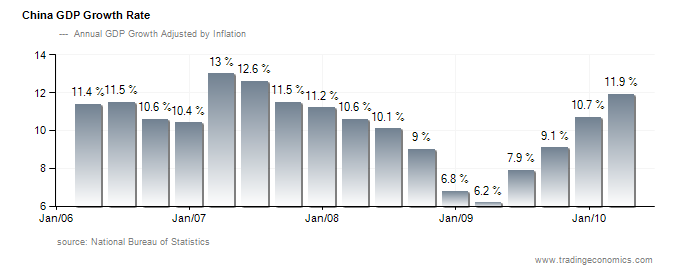
A sizzling 11.3% growth in Q1 and a consistent 8% plus avg. growth that has been envious...While the Chinese will do anything to keep unemployment down....


Recipe for Inflation: China mostly is in the grip of a bubble as its property markets are indicating and are so are credit markets. People's Bank of China recently revealed that in March the output gap reached more than 3%, the highest level since 1998 and the seventh straight month of increase. Positive output gap indicates that factories are running out to comply with high demand which in turn is likely to push prices even higher. This looks very inflationary for China in conjunction with the very level of money supply.

People's Bank allowed lending to surge starting in late 2008 to fight the global financial crisis. New loans rose to a record 9.59 trillion yuan in 2009 and banks advanced another 3.38 trillion yuan in the first four months this year. The Shanghai Composite index of stocks has fallen off more than 2o% this year, the worst-performing index in Asia, as investors sold Chinese assets on concern a withdrawal of stimulus spending and a slowdown in construction could choke off growth after an 11.9% expansion in the first quarter. (Thanks CNBC)


In Shanghai fears abound that property speculators chasing quick profits are inflating a real estate bubble. Apparently, the Chinese Government is also worried about this and is now capping prices and making some building loans harder to get.

Re-orientation critical as current strategy has outlived utility

Besides PBoC's March 2010 data, that China is facing serious overcapacity problems goes beyond real estate. According to Prof. Michael Pettis lectures of Peking University, China's understandable efforts to try and shield itself from the world economic crisis with a massive stimulus package may end up making its situation worse. I am also getting a feeling that China has reached a point where it is producing stuff or investing in infrastructure that is not economically viable; that in the future China is still not going to be able to use this stuff and Chinese people are still going to have to pay for it despite the negative NPV of so many road projects.
Pettis conclusion is stark "when that happens that will exchange future growth in exchange for the growth that we got today." "What we've seen in the last year has been a very robust reaction to the contraction in the export sector and to the threat of rising unemployment." Professor Pettis says China entered the global financial crisis with an investment rate that was probably much too high.
Look at the Chart below and it is easy to understand why China needs to stimulate consumption. The economy is way too heavily dependent on investment. Since investment rates is so high there's a very, very strong reason to believe that a lot of this investment is being wasted. Considering the monetary policy in place to allow for easy access to capital, repayment nightmares could become a big potential issue that makes any growth very inefficient....


China is not imploding any time soon as doom mongers seem to suggest.....nothing the Chinese cannot handle...

U.S Stock sell off part of exaggerated macro concerns: Not fully warranted

I will dedicate a post shortly on how to read macro data and link it to IDD Magazine's M&A data...but for now...

As I said earlier the PMI data, consumer index and jobs data trend (not last week's blip) should have given equity markets hope and not made them react knee-jerk fashion as they did this week in the sell-off

...Greece seems to have brought out the fears of a 'Coupling Contagion' in the U.S. An overdue correction has occured, which is partly understandable.

I feel that the stock sell off in the U.S. is not based based on a sound basis, and has become an  exaggerated reaction to Europe, some of them are

1. Euro fall leading to U.S companies earnings getting hit (U.S is more dependent on exports esp. technology and capital goods) - partly true, but the dependence is not that great either

2. The ECB version of TARP is not helping as it is leading to fears of more hidden losses (local guys know best, if they are yanking out...hmmm it is better to take a cue) 


My View: ECB is not helping, but to premise the US sell-off on this would be exaggerating its impact considerably and also ignores promising U.S Macro indicators trend

3. Fears of a general slowdown and indeed deflation (Oil Futures got whacked big time) 


My View: Again , Europe's mess is bad, but to base global demand and indeed economic prospects on it would be to miss the forest for the trees. The attention should be on Asia, Brazil, US and other


Whether we may like it or not, Europe's role will continue to decline. The Frame of  Reference needs to change

4. In the short term, the bad jobs data also contributed to negative sentiment in a market that was overdue for a correction 


My View: Again, the jobs data was a blip. The trend has been indicating a recovery...please see my post on May 22 or May 23....


The above video is an interview by renowned expert Ed Yardeni of Yardeni Associates. he touches upon a number of these topics...

ECB Stimulus: Doing a Drachma on the Euro and losing credibility

It is better not to use sweeping terms, but the fact remains that the 1 trillion US$ ECB bail out could have been used better in cleaning up the mess after permitting the Greeks to default. Now, what is happening is the Euro is being put through the 'Drachma effect' of depreciating. The ECB has lost credibility and the financial crisis is much larger now. In addition, the damage to the ECB in buying these 'sub-investment' grade securities is going to hurt it even more....

This is good in a way as it will stimulate exports. But it is bad for the rest of the world because foreign operations of firms in Europe will be impacted negatively. It is going to take a long time as the Euro is here to stay. Any attempt to re-introduce old currencies will be disastrous as the liabilites denominated in Euro will result in immediate default and collapse owing to currency depreciation.

The ECB is going to lurch out slowly and stagger out of this problem eventually.....an unwanted mess...we could have cleaned up much better had the Greeks defaulted...

Wednesday, May 19, 2010

Morning Coffee Extra: Euro Commentary

As I said in an earlier post, the Gordian knot of interlinkages between macro indicators and markets keeps getting crazier....

                                                EUR-USD: Intraday (May 18, 2010)
                                  Source: BBC, May 18, 2010


The Euro is continuing its fall as the markets are not confident about the bailout and are even more worried about the fiscal conditions of Eurozone Govts. as mountains of debt pile up. Data from Bloomberg indicates that the euro slid below $1.22 after Germany said it will ban naked short-selling and naked credit-default swaps of euro-area sovereign debt and the Bank of Italy allowed lenders to exclude losses on government bonds.

A general drop in stocks and commodities spurred investors toward the safest assets.  

Rapid re-pricing of risk is occuring as the worries over the bailout gets replaced rapidly with worries about Europe's fiscal solvency and deflationary pressures. As the chart from the BBC shows, the euro fell as much as 1.9% to $1.2162, the lowest level since April 17, 2006. (Silver lining: European exports will get more competitive......but thats for later)

Naked Shortsells and Naked CDS banned: Further downside for the  €

Germany’s financial-services regulator has introduced a temporary ban on naked short-selling and naked credit-default swaps of euro-area government bonds. This has caused further pressure as markets reacted by further selling the Euro to indicate their discomfort with what is happening  (have a basic question: what kind of participants do we have anyway?)

A 'Naked' Primer from Bloomberg: When securities are sold naked, the trader fails to borrow the assets before sending an order to sell. Investors own naked credit-default swaps when they don’t hold the bonds the derivatives are linked to.

Hidden weaknesses? New Skeletons in the cupboard?
The Bank of Italy has permitted Italian banks to opt for new rules aiming at “neutralizing” the effect of capital losses and capital gains on regulatory capital from holding European government bonds. Hmmmm.......that step gives a lot of information out.....

It is possible that the Italian bank balance sheets remain weak and have no bandwidth for fresh losses......and that raises a more disturbing possibility....somewhere way down the line there may be some sort of debt restructuring......more negative feedback into the loop.....

While short-term interest rate support from the ECB has to be continued...the € will have to trade cheap to sustain interest whilst under such scrutiny....

Tailpiece: Is the UK watching?

Righto... next up: Oil......

Morning Coffee: ISM Data and Consumer Confidence Index indicate Hope

The latest ISM Data and spending index should be good news for i banks down the line.....Oddly, good PMI and jobs data are not getting the traction they ought to have deserved as fiscal abilities of governments are coming under renewed focus...

First off, As CNBC said last morning, some of the biggest US companies are taking signs of an economic slowdown to heart, scaling back on their earnings projections anticipating tougher times ahead. The debt situation in Europe, the withdrawal of government stimulus, and lately fears of a deflationary implosion are giving jitters sending investors looking for cover.  Bonds seem to come across as a haven in a low yield and apparently deflationary economy. The Gordian Knot is growing tighter and not looser....

Recovery? ISM and Jobs indicate so: As the above chart shows, at 60.4 the ISM index is at its highest since 2004. According to the ISM, a PMI in excess of 42%, over a period of time, generally indicates an expansion of the overall economy. The current figures show an expansion in the manufacturing sector for the ninth consecutive month. According to ISM, The past relationship between the PMI and the overall economy indicates that the average PMI for January through April (58.7%) corresponds to a 5.6% rise in real GDP. In addition, if the PMI for April is annualized, it corresponds to a 6.2% increase in real GDP annually.

The recovery (nascent though) more closely resembles the “new normal” that executives at bond giant Pimco have predicted with embedded fears about sustainablity. Most recently, those fears have manifested in weak outlooks from some key companies.


The debt problems in Greece, Spain and elsewhere have spun a whole other set of worries, primarily centering on an economic slowdown that might snowball... despite a whole lot of encouraging indicators

Consumer Confidence Index up at 61.4: According to Lynn Franco, Director of The Conference Board Consumer Research Center: "Consumer confidence, which had rebounded in March, gained further ground in April. The Index is now at its highest reading in about a year and a half (Sept. 2008, 61.4). Consumers’ concerns about current business and labor market conditions eased again. And, their outlook regarding business conditions and the labor market was also more positive than last month. Looking ahead, continued job growth will be key in sustaining positive momentum." (Thanks to the Conf. Board for permitting the quote)


I wonder what is it with all these doom prophets....But I will explain how to read data in another post...it is important to make one own's deductions rather than get influenced

Monday, May 17, 2010

M&A's new contours: The Re-financing time bomb

Ken McFayden came out with an excellent article in the latest version of the IDDMagazine. I will try to summarize it and add my own take on the thing..... 

The article describes how valuations in M&As are falling short of valuations. Recently the S&P 500 and Dow Jones industrial average hit 18 month highs owing to factors like better employment reports, improving ISM number indicating an improving economy. While the PIGS’s debt problems have reduced some of the gains in stocks, the broader indexes remain high. The bullishness for stocks, however, doesn’t necessarily preclude acquirers from bargain hunting, as some deal pros believe that in the current environment — marked by rising share prices and looming questions over financing — “take-under”’ could become a more common occurence.


This new undervaluation is due to the fact that few CEOs are seeing any material earnings growth, and most recognize that down the road the cost of capital is ­climbing. With the stimulus winding down and the Fed indicating its accomodative stance might be moderated, companies are realizing that capital is going to be expensive down the line.
 

Re-financing Time-Bomb: According to IDD and Fitch, roughly US$ 770 billion in leveraged loans will come due by 2015. This may leave companies with no alternative other than to find a buyer, even if the sale price represents a discount to the market valuation. This was the option facing InfoGroup in March. The Omaha, Neb.-based consumer database provider agreed to a roughly $460 million deal, valuing the company’s stock at $8.00 a share. Private-equity firm CCMP Capital Advisors, the buyer, submitted the best offer, which came in under InfoGroup’s share price, opening at $8.16 a share on the day the deal was announced.

Indeed, as Government support winds down PE driven M&As are likely to pick up pace as firms look elsewhere for support.

                           IDD Magazine May 2010: Underwriting Fee Table


HP-Palm Deal: Most recently, analysts speculated that Palm Inc. could have been the latest take-under target after a lackluster earnings call in March. The problem facing Palm is the cost of capital, as the company, as of press time, had US$591 million in cash and short-term investments, but was burning through its funding with losses amid weak sales and high research-and-development and marketing costs. The US$1.2 billion sale to Hewlett Packard represented a premium to the company’s stock price immediately ahead of the sale, but was valued significantly less than a secondary offering, floating shares at $16.25 per, in September. Again, the growing cost of capital and the impending refinancing issue loomed large.

As a leading commentator notes unless performance improves markedly a lot of acquirers will have grief down the line as the value of the acquired firm will be considerably less. I think that add the debt bomb and the transfer of debt burden to the private sector...it is enough to give the toughest folks guaranteed sleepless nights......

Gold and Interlinkages: A Commentary


2 days back Micheal Aronstein of MarketField AMC was echoing the sentiment being felt in the market when he remarked that he would consider the setting up of the Gold ATM in Dubai as a sign that things have got really odd w.r.t Gold. I agree because Gold has indeed behaved contrary w.r.t the other major variables like stocks, currency etc.. for a number of reasons. While the reason for 'safe haven' investments remain convincing for many, bubble situation in the bond market and the heating in Gold is unsettling.

I am all for Gold being a part of the portfolio. My ideal portfolio will have 4-5% Gold in it. As Businessweek notes, "It's true that gold kept pace with inflation in the 1970s. The annual increase in the consumer price index averaged 9.3% from 1973 through 1981. The market price of gold at the end of 1972 was $63.91, rising to $456.90 by the end of 1982. That's a 615% increase, compared to cumulative inflation from 1972 to 1983 of 138%". While I am sceptical of Gold being an inflation hedge, nevertheless I consider it a prudent part of any diversified portfolio.

Arguably, gold's record as an inflation hedge has been at best mixed in the long term. Data from Bloomberg shows that gold fell from 1980 to 2001 with the metal's total appreciation from 1972 to 2001 was just 337%. That barely beats inflation over those 29 years of 323.7% and is way behind the 2,466% return of the broad Standard & Poor's 500-stock index if dividends are included.

 When I was writing my Analyst report in Mongolia, I used Kitco's data to talk about 'Coiled Spring' momentum in Gold (Chris Dahaemer is a strong proponent of the same). I had given a range of 1250-1340 US$ for gold during May 2010- January 2011. Now,  Gold spot prices hit a record of $1,243.10 per ounce in Comex trading on May 12 before slipping $13.90, or 1.1 percent, to $1,230.10 on May 13. In the past three years, the precious metal is up 80%. But it has behaved in a volatile manner as the charts indicate.


While I think Gold still has some upside, the bubble mentality has become too big to ignore.
The fiscal crisis in Europe, high deficits in the U.S., and fears of inflation might be justified As Money Manager elser says, Unlike bonds, no one pays interest to holders of gold. And, unlike insured bank deposits, there is no guarantee of your principal investment and simply put no downside protection.

Opinion: At best in my opinion, Gold is a trading tool in a difficult market esp when the yield curve is flattening. Right now, with the ISM the strongest since 2004 (>60) and earnings, macropicture looking up, the yield curve should stay normal indicating sustained belief in an economic upturn.

I would say considering the info. above, Gold could be in for a correction of 10% or above in the downward direction in the next quarter

The movement of 17% in the VIX and the fall in Crude to 72 US$/bbl is indicative of fears in Europe rather than issues with fundamentals...

Tailpiece: Focus on the stretch between November 07 and September 08 and again on the stretch between Dec'09 and May '10. The metal has seen swings in excess of 10%.


Sunday, May 16, 2010

M&A Landscape Q1 2010: Asian deals up 197% YoY at US$ 139 bn; World at 573.3 bn US$


                Source: Thomson Reuters, April 2010

Sectors driving M&A: Financials, Energy and Power

According to Bloomberg and Thomson Reuters, M&A activity in Asia (or Asian involvement) amounted to US$139 billion, up 197% over US$46.8 billion in the same period in 2009. Globally Asia accounted for 24.2% of the US$ 573 bn worth deals in Q1-2010. First quarter volumes were driven by Prudential's US$35.5 billion acquisition of AIG's AIA division, which was the largest deal thus far in the Asian insurance industry. However according to Reuters, The transaction fell short of the largest deal of all time in the region: PCCW's US$35.6 billion acquisition of Cable & Wireless HKT in 2000.

Financials were the most targeted sector with a 39% market share from US$54.2 billion in deal activity. Energy & Power followed with US$15.1 billion, capturing 10.9% of the market.

Chinese Dragon: China cross-border M&A was worth US$18 billion, a 155% increase from volume recorded in the first quarter of 2009. Outbound activity amounted to US$14.6 billion while inbound activity totaled US$3.4 billion.

Australian M&A increased by 50.4% to US$28.4 billion from US$18.8 billion last year and marked the highest first quarter volume since 2007.
 
Worldwide M&A: World M&A was up 21%, while number of deals were up 4%  while the value of worldwide M&A totaled US$573.3 bn during Q1-10 (20.5% growth over Q1-09). It seems this is the strongest opening quarter for M&A...
since 2008. By number of deals, M&A activity is up 4% compared to last year with over 9,000 announced deals. However compared to Q4-2009 deals were down 5% from 601 bn US$.

Advisory fees rises 19% - According to estimates from Thomson Reuters/Freeman Consulting, M&A advisory fees from completed transactions totaled US$5.5 billion for the first quarter of 2010, an 18.9% increase from the first quarter of 2009. Deal activity in the Americas accounted for 49% of the worldwide fee pool, while Europe, Middle East and Africa accounted for 32%. Asia Pacific and Japan contributed 14% and 5%,
respectively.

The Energy and Power sector was most active during the first quarter of 2010, commanding 20% of announced M&A while the Financials and Real Estate sectors accounted for 18% and 12% of M&A activity, respectively. Deals in the Telecommunications, Consumer Staples, Real Estate, High Tech and Retail have all experienced triple-digit percentage gains over the first quarter of 2009.

Rise in European Public Debt: Suffocating the Private Sector whilst it is on CPR

I fear that the EU has merely kicked the can down the road and whats worse is that Greece is getting no where to solving its actual problem and so is Spain... Anyway Greece first... The 1 Trillion USD rescue package seems to have restored calm and hopefully stopped a contagion...but I fear that the broader effect is that the ECB and Governments in the EU are de-railing the efforts to start off the real economy! 

I feel that all the EU is doing is shifting the problem around from the banking to the government sector. As CNBC reports rather correctly, Having taken the burden off the banks and the private sector in recent years, the focus on sovereign debt will simply see the burden transferred back to the private sector. As Monument Securities points out "The EU and the IMF sought to meet the threat through what, in essence, is yet another exercise in shoveling troubles away from those areas where the markets are looking towards less intensively-observed sectors of the financial system."

Greek Solution or ?: The IMF and others seem to have identified correctly that Greece and the PIGS in general need to make structural adjustments to their economies to make them more sound. But the solution for Greece is at best a partial one and may not be required in that intensity... Greece, Spain and Portugal have begun the process of cutting spending... Greece is planning a minimum 9% cut in spending...

Barking up the wrong forest? Here lies the problem. Greece needs to boost revenue collection in addition to rationalizing spending. That is going to happen if and only if Tax regime is revamped and the uncompetitive structure of Greece'e economy visible in terms of family controlled businesses is changed quite a bit. Spending cuts and no revenue rises will complete a deflationary double whammy for the Greek economy and may do so for Spain too. The spending cuts alone will reduce domestic demand that will follow from budget-cutting measures in these countries diminishing the tax base and increase the cost of social transfers.

The Result? Fiscal adjustment will shift the burden of debt back to the private sector and the banks reversing the stimulus of Fiscal 2008-09. Since the banking sector has yet to address many of the problems like the bad loans that led to the crisis, moving debt to the private sector could be disastrous for the industry.

I agree with assessments that the conditions for sustainable growth will only be restored after prolonged deleveraging, with final demand running below supply, in the debtor countries.

Simply put, Greece will have to

1. Rationalize Spending (rationalize on indexed pensions and atrocious civil service benefits)...donot reduce

2. Enforce tax code (Focal Point, This is a sina qua non condition)....donot drive capital away (afraid already a lot had left Greece)

3. Boost Competition in business (Greek business is notorious for stifling innovation and competition)...dunno how this can be done though!!!...private sector is the key

Points 2 and 3 should be prominent and not point 1. As of IMF and co have focused on Point 1. You cannot suffocate a person when you are giving him CPR....

The following schematic should help further understanding.... it is crucial to use economic theory to show why the above arguments are important.

Courtesy: New America

Saturday, May 15, 2010

Bonds: Yields rise as Euro related worries trump good US Retail news


EUR/USD- 1.24 at Friday (May 14)
US 30YT = 4.33%
US 10YT = 3.46% (up from 3.44%)
Yield Curve: Normal

Persistent worries regarding the Euro zone is causing concern resulting in a 'flight to quality trade'. U.S. government bonds rallied on Friday as persistent worries over the euro zone's debt crisis led investors to move from stocks for the safer harbor of Treasuries. The bond market shrugged off data showing a bigger-than-expected rise in April U.S. retail sales, focusing instead on the slumping euro, which fell to an 18-month low against the dollar, under $1.24.


Source: Bloomberg, May 15, 2010

Summary of Markets:
 
As Business Week summarized, Stocks fell around the world, oil fell and bonds rallied on the prospect of weaker growth and lower corporate earnings as doubts arise afresh on economic recovery and especially the 1 Trillion gamble by the ECB and Co.
 
I for one want to see more details of the 'sterilization' plans of the ECB
 
CDS Indices and ITraxx Europe: The other part of this 'flight to safety' is indicated by the Markit Itraxx index family. Data from FT and Markit show that the Markit iTraxx Europe index widened by over 12bp to hit 110bp by May 14, while the Markit iTraxx Crossover soared through the 500bp mark to finish 50bp wider at 508bp. Pressure resumed on the sovereigns, with the Markit iTraxx SovX Western Europe index climbing 13bp to close at 123bp. That fed through to the banking sector and the Markit iTraxx Senior Financials was 19bp wider at 147bp...
 
 
              Courtesy: Financial Times
 
The ECB's umbrella wont do...Greece and the PIGS should avoid their favorite past time of 'getting themselves drenched in fiscal imprudence'
 
As Sir Humphrey Appleby put it so eruditely ' Change horses midstream and you might find yourself up a creek without a paddle'
 
Extra:
 
US Muni News and BAB: According to the "The Bond Buyer’s weekly" yield indexes increased a bit last week though the secondary market continued to be dull. Apparently last week's volatility in the equity markets has put a damper on US muni activity. According to IDD magazine and Eaton Vance, "For institutional investors, there’s a relatively manageable calendar, and the June-July reinvestment approaching, so they’re not rushing to sell,” “The dealers aren’t really rushing to sell, either. The demand is soft, and there’s no pressure to sell. It’s just been quiet. Every afternoon, activity has just tailed off; there’s a summer-like effect.”
As reported by Bond Buyer magazine, In the new-issue market this week, Citi priced $789.8 million of debt for Seattle, consisting of tax-exempt bonds, taxable Build America Bonds, and taxable recovery zone bonds. Bank of America Merrill Lynch priced $750 million of taxable BABS for the New Jersey Economic Development Authority, the BAB market’s largest-ever floating-rate note sale.


Analysts said investors were overlooking the data and focusing on fear and uncertainty over Europe's troubles and what they might mean for global markets and the economy. To me this looks really concerning as the bond market has already seen such huge influx of funds as I have said in my earlier posts...

Virgil was right after all, we should fear the greeks especially when they bear gifts like these...

Monday, May 10, 2010

Euro Zone problems reach contagion proportions

Sleeping dogs can rarely lie still if the cat is out of the bag

European Union finance ministers sought agreement on Sunday on emergency measures that could be worth up to 600 billion euros ($805 billion) to prevent Greece's debt crisis spreading to other countries in the euro zone. Vowing to do everything to defend the euro against the "wolfpack" of the financial markets, which have been pounding Greece, Spain and Portugal, the ministers discussed much larger sums than previously to try to end the market turmoil.

EU sources said Germany, which faces public opposition to bailouts, was resisting any deal that put no limit on the potential financial assistance for countries such as Portugal, Spain or Ireland and wanted the IMF involved.


But a compromise was being discussed that included loan guarantees by euro zone countries worth 440 billion euros, a stabilization fund worth 60 billion euros and a 100 billion euro top-up of International Monetary Fund loans, they said. "We now see ... wolfpack behaviors (on markets), and if we will not stop these packs, even if it is self-inflicted weakness, they will tear the weaker countries apart,'' Swedish Finance Minister Anders Borg told reporters in Brussels. U.S. President Barack Obama spoke to the German and French leaders by telephone to reinforce the need to calm jittery financial markets quickly and ensure the global economy is not jolted by a sovereign debt crisis.

Economists estimate that if Portugal, Ireland and Spain eventually require similar three-year bailouts, the total cost could be 500 billion euros. Comments by the ministers, and by heads of state and government from the 27-nation EU who called for a new anti-crisis mechanism in talks on Friday, showed greater urgency from a bloc that fears for its future if the crisis is mishandled. The sums that EU sources said were being discussed dwarfed those considered at previous crisis meetings and deals that have failed to contain the market turmoil, which has made Greece's borrowing costs unsustainable.
In early Asian trade on Monday, the euro extended its recovery from 14-month lows and was up almost 2 percent against the dollar. The single currency rose 3 percent versus the yen.
Commission Proposals

Greece, with a budget deficit of 13.6-14.1 percent of gross domestic product in 2009 and debt of more than 115 percent of GDP, has secured a 110 billion euro three-year loan package from the 16-country euro zone and the IMF.

The EU executive, the European Commission, wants to ensure other vulnerable countries can stave off similar crises. The European Central Bank is also expected to play a role in the containment efforts but it is not clear what. EU sources said ECB governors discussed the crisis on Sunday but no details were available.
"I see a 'magical' triangle that can provide a solution: the EU finance ministers, the ECB and the affected countries,'' said Austrian Finance Minister Josef Proell.

The Commission has proposed a stabilization framework to provide a safety net for other euro zone countries with high deficits and debt, and wants an aid mechanism for non-euro zone countries extended to nations in the single-currency bloc. EU sources said the Commission wanted the amount available under the mechanism, called the balance-of-payments facility, to be raised by 60 billion euros. The maximum available now is 50 billion euros. "The Commission has put on the table ... a proposal that is ambitious and comprehensive ... to enable the Union to borrow on the international markets but also looking beyond the community budget to bring member states into the mechanism,'' a European Commission official said. A similar mechanism was successfully used in the cases of Latvia, Romania and Hungary after the pool of money available was increased to 50 billion euros last year. A German government source said Berlin wanted the IMF involved in the safety net mechanism and made clear tough conditions must be attached to any loans. "The government will insist that the IMF—as with the Greece case—participates in any possible bilateral aid,'' the source said. Chancellor Angela Merkel faces deep popular opposition to her decision to release aid to Greece. Voters punished her center-right coalition in a state election on Sunday, depriving her of a majority in parliament's upper house. German Finance Minister Wolfgang Schaeuble was admitted to hospital on Sunday after an apparent bad reaction to medicine and missed the ministers' talks.

Sunday, May 02, 2010

US Bond Market Bubble: Support


These are support images for the prior post on US Bond Market Bubble. Essentially these are data from ICI Institute and from CNN Money showing net cash flows and yields on bonds over 1995-2009 and also the current spreads between US Treasury bills and Corporate Bonds.

Another aspect that points to a bear market in addition to the frightening volume numbers is the Gold Spectator web page's BEV Chart
. The Red Yield Plot shows that the US T-Bonds rising during the Stock Market Crash of October 2008. The Current Yield dropped over 200 Basis Points as the DJIA fell below its BEV -40% line.

Gold Spectator(GSR) analysis makes an interesting point that, despite seemingly rising flows, since October 2009, as a Debt Crisis stirred in Europe (worsened by April 2010 with PIGS in big trouble), some money has been slowly walking away from the US Treasury Bond Market. So the question we should all ask ourselves is whether this money is Smart or Dumb Money? GSR think it’s Smart Money and my own reading of a previous Societe Generale report correlates this opinion that too much speculative money is in bond markets with no clear objectives, a sure recipe for pain.

It is quite possible
we may be witnessing the early stages of a crisis in the US T-Bond market.

Is that possible? Yes, it’s happened before in the 1970’s. Before the 1970s, came the 1950s & 60s.All-in-all, these were 30 years of losing money in the US T-Bond market. But in the 1970’s, the flood gates of US Monetary Inflation opened wide, and US T-Bonds earned the moniker of “Certificates-of-Confiscation.”

The 2010 crisis might come on a lot more quicker and if that happens, the ensuing crisis will dwarf the 2008 debacle.

US Bond Market Bubble? Fund flows indicate yes

According to the Investment Company Institute, investors have poured almost US$ 375 bn into bond funds since the start of 2009 and in aggregate there is more than US$ 2.2 tn invested in bond funds. This massive inflow of money into bond funds and the government's purchase of government bonds as part of its quantitative easing program has made yields in the bond market come down substantially since late 2008. These bond flows are all not done wisely. Quite a bit of it been speculative and based on naïve misplaced notion that bonds are less risky. As a Societe Generale report of January 2009 notes, such investors are in for a bad surprise when rates rise in the second half of 2010 and yield curve flattens. Ditto when the ISM picks up and GDP growth sustains itself above 2.5%, bond yields will go down.

Is it a bubble then? As CNN Money opines rather correctly, the answer is nuanced. From a longer term perspective, bonds are, broadly speaking, at near all-time lows in yield. In particular, given the current loose monetary policy being implemented by the Federal Reserve, Treasury bonds are at close to all time lows in yield, and therefore highs in price. Given this extreme in Treasury bond pricing, there is clearly bubble potential in the U.S. government bond market.

Currently, 20% of all US mutual funds comprises of bond funds. The picture gets starker if the flows are considered from December 2008. Billions have exited the equity markets and have gone into bond markets. Eventhough 44% of all mutual funds are equity funds (44% of 11.1 trillion AUM in the US), outflows have been greater from equity funds on a net basis. According to Michael Belkin since last March on an average bond market funds are seeing inflows of US$ 4 bn a week while equity funds barely manage US$ 500 mn a week.

The Bond Bubble term has been bandied around for the past three years. While it is easy to make a call that an asset class is in a bubble, it is more difficult to predict timing of such a call. In addition, a bubble inherently implies that the unwinding of that bubble will be a crash. So far both have not materialized.

Charting the spread of corporate junk bonds bond versus 5-year treasuries and corporate investment grade bonds versus 5-year treasuries going back to 2002, while yields for both investment grades and junk bonds are close to their lows in yield for this period, currently at approx 8.24% versus their low of 7.75% for junk bonds and 4.7% versus their all time low of 4.5% for investment grades, the spreads between 5-year treasuries remains relatively wide. In fact, these spreads bottomed in 2007 at 0.93% for investment grade and 3.1% for junk, versus their current spreads of 2.30% and 5.74%, respectively.

The case for a US Treasury Bond Bubble: Since the price of bonds should never be taken in isolation, if there is a bubble in bonds, it is likely related to Treasuries. The case for the Treasury bubble is effectively three-fold:

1. They are being priced based on extreme monetary policy that will not be sustained in perpetuity.

2. They are incorporating very limited expectations for inflation, which we believe will occur and perhaps in dramatic fashion.

3. Finally, government bonds will eventually have to reflect the declining credit worthiness of the US based on the United States' deficit as a percentage of GDP and growing debt to GDP ratios. After health care commitment deficits have crossed 10% of GDP

Treasury bonds cannot stay at their current yield level forever. And while we have seen some correction, yields and prices for U.S. government bonds are still at generational extremes. In reality, though, just as it took decades for interest rates to come down from the meteoric highs of the 1980s, it will take interest rates time to go up, and it is likely that no crash is imminent. So even if there is a bubble, there won't likely be a "pop." This move will be long and sustained.

As CNN Money notes, from an investment perspective, the most effective way to play the re-pricing of Treasuries over time is to be short Treasuries out right, or to play a narrowing of the spread between treasuries and corporate bonds.

Small Note on Greece: While unrelated, however, Greece indicates the dangers of high bond market yields reducing equity flows as the markets are connected. Higher yields make bonds attractive and affect fund flows into equities. This will be discussed separately.

Friday, April 30, 2010

Greek Debt Crisis: Moratorium Compromise? - Part II

Contd. from Part I

Are high debt ratios and public spending issues rare in S.Europe?

Such stories are not new in South Europe. Indeed it is typical of Southern European economies that are quite different from their Northern European cousins. Spain's woes are similar with a real estate bust, soaring public deficits and unemployment etc amongst a motley of reasons have caused S&P to issue a downgrade with a negative outlook.

Why are these rating downgrades being discussed in much detail?

Simple. Because of the impact it will have on Greece's banking sector and the ensuing ramifications for Greek economic stability that will serve as harbinger of what is in store for Portugal, and Spain. While media comparisons and dark mutterings about the debts of UK, Japan and US abound, the fears of a contagion are at best overblown. But the implications for Greece are serious because,

In international capital markets and specifically in money markets, bonds and in particular, government bonds tend to be used as a collateral to fund money market operations. For instance, if Greece cannot use bonds as collateral, then Greek banks lose upto EUR 17 bn in funds (Source: Risk.net). For example: The National Bank of Greece (NYSE: NBG) uses Greek Govt bonds for 45% of its ECB repos. Get the picture? it is worrisome if the domino indeed sets off as the solutions are unpalatable and in cases impossible to implement.

It is now generally agreed that even ECB's relaxed rules allowing BBB- debt as collateral might not be enough to save Greece. As Roubini noted, "This might be the tip of the iceberg as far as sovereign defaults go". He has a point, public finances have been massively re-leveraged since 2008 as fiscal stimulus, tax cuts and underwriting of private sector losses have pushed deficits sky high across the western world. This has two possible outcomes if not reversed a)High Inflation b) debt (and default)

Ofcourse, the 'doom' delphi is correct about the twin outcomes. However, as I said in Part I, this issue has to do more with the internal dynamics of the Eurozone rather than some worldwide phenomenon. UK, US are another story.

Is cutting public services or reducing spending by 9% as bandied around the solution?

Well, the argument that spending needs to be cut is correct. It is at best a partial remedy. As one Greek expat in the US noted in the NYTimes, cuts to spending need to be accompanied by basic changes to the structure of the Greek economy as I said earlier. Especially structural changes that boost the competitiveness of the Greek Economy are critical such as removing the stranglehold of family businesses and boosting entrepreneurship. Taxing rationally would do good as well. The current taxation regime is ridiculous as is enforcement.

Some solutions floating around and my views:

Allow Greece to exit the Euro: While not impossible, it will be a horrible process with bad consequences. Technically, Greece could withdraw from the EMU and as a result from the EU and issue the Drachma again. But with 300 bn in USD and EUR denominated debt, the ensuing pressure on the Drachma and rising interest rates would be too hard to manage. This would mean 'restructuring' or 'haircuts' with debt partially written down. this would cause even more problems with higher debt leading default in a somber progression

devaluation ----> debt ------> default

Verdict: Best not attempted

Haircuts: Another bad idea in this case. This could turn really bad not only for Greece but for the other 'PIGS' in the pen they might not want to hold any member's debt who is under threat of default. This could lead to capital flight with adverse economic consequences.

Verdict: a big no

Outright Default: This will make Greece a 'debt market pariah' for atleast half a decade or till the time their economy has been significantly restructured to prevent defaults in the future.

Another No

Moratorium with some restructuring: A five-year moratorium on Greek debt repayments would be one solution that can keep investors satisfied at a lower cost coupled with select restructuring. As a commentator said, this would amount to a "soft default" which would offer Greece the timeframe for fiscal consolidations. While it is a default of sorts, the US$ 159 bn aid package and time to accelerate fiscal consolidation and improve economic competitiveness gives everyone the best chance to ensure the mess never occurs again .

That would be crucial to ensure the Euro succeeds as an experiment....

Denmark is one such precedent that comes to my mind...

Is the Fed risking Inflation to continue to support the Recovery?

The Fed said in a recent meeting that, Inflation concerns were benign and that it would keep rates lower for an extended period. Jason Cummins of Brewan Howard Asset Management noted that 50% of the consumer Index was in deflation region. However, I find that a bit contradictory because 60% of the US CPI index has been rising in the last year while the 40% represented by rent/shelter had dragged it down (see the graph later in the post for CPI excl. rent component). Then I saw the US PPI data and that points to what I feel is an oncoming rising inflation cycle. I disagree with Cummins' conclusion while sharing his view on the Fed having real tough policy choices..anyway back to Inflation and the PPI....

Example: US PPI went up unexpectedly in March, rising 0.7% against forecast 0.4% and February’s -0.6%. This translates to over 6% on an annual basis in March 2010. With core CPI rising by nearly 1% YoY, with much of the increase in prices is related to rebound in commodity prices (viz. food and energy), there is a risk that this temporary inflationary surge translates into a more generalized pick up in inflation and inflation expectations. This could have the impact of rising wage and salary costs even as unemployment remains extremely high. Thus the risks for US inflation remain to the upside. (part of this is from marketwatch)


This is where Jim Bianco's take on Inflation becomes very interesting. As mentioned earlier, Bianco correctly says that the 60% basket of the CPI comprising food, gas, utilities etc.. have been on the uptick since the last 3 quarters as commodity prices have rebound.

Whats the bad news?

Well, the other 40% namely rent/shelter was kept low through Government tax credits for housing causing rental demand to slow down. With this measure expiring today, the demand for rentals will move upward. Thus the 2.3% figure quoted by Bernanke is at best incorrect. The US CPI should move into the 3% territory around end June 2010 as the effect of the tax credit begins to die out.

This only leads to one conclusion...

The Fed is risking higher inflation to sustain growth (The Fed or any central bank has one basic question in front of it always: do i foster growth ot stabilize prices?). The Fed is soon going to face the fact that the above objectives will go in the opposite direction shortly. The policy dilemma seems to go the way of low rates atleast till December 2010.

In my opinion, We might see a hike in the fed funds rate in Jan or Feb 2011. But if you see my tail-piece below, you may realize why the Fed is in a tight spot..

My conclusion is also connected to three other elephants in the room: soaring deficits, looming bond bubble and potential damper of Fed action on equity markets. Each deserve a separate post.

Tail Piece:
(Policy is also complicated due to the amount of long-term mortgages held by the Fed. A rate hike might end up undoing the Fed's efforts to help banks...we will see that in another post)